Hey,
my name is Arielle and I’m a writer. After my graduation from Stanford University, where I studied English and Creative Writing, I worked in publishing for two years before transitioning to freelance, primarily working in tech theatre and as a seamstress. In my free time I’m a passionate circus aerialist and weaver, though you can occasionally also find me lurking in a letterpress studio or scrubbing decks on a hundred-year-old sailing ship. I currently live in Philadelphia with my wife and our cat Peppercorn.
Short Fiction
Owen
The owner of the apartment—Owen, he had said in the few messages they exchanged on Craigslist—appears to be a hoarder. His room is full of shelves, and the shelves are full of things. Children’s books and young adult fiction and a few novels for adults. A huge stack of dust-coated CDs in the corner. Tchotchkes everywhere. Seashells with words carved into them, jam jars full of rocks, stress balls, small enamel boxes, coins from around the world, figurines of crocodiles, interesting picture frames with nothing in them.
Jay imagines him: short, dark-haired, bespectacled, coming home with these small souvenirs and putting them on the shelves. He pictures him lying on the ground rereading childhood books. Peering in darkened antique store windows and museum gift shops for things he can add to his collection.
He moves into the kitchen, glances at the empty fridge and dusty cupboards. Owen left him some instant coffee, a few boxes of stale breakfast cereal, a large number of three-quarters-empty bottles of Windex and stainless steel cleaner under the sink.
tell me how it tastes
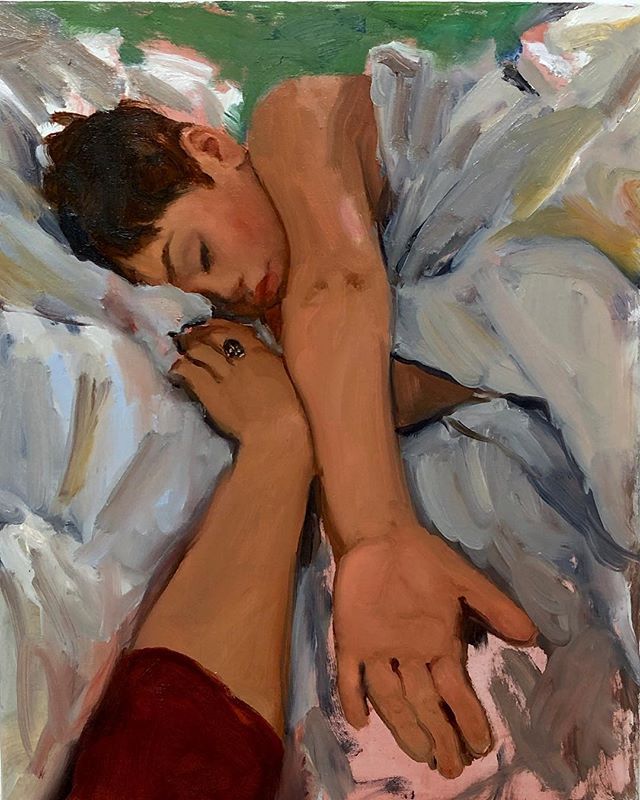
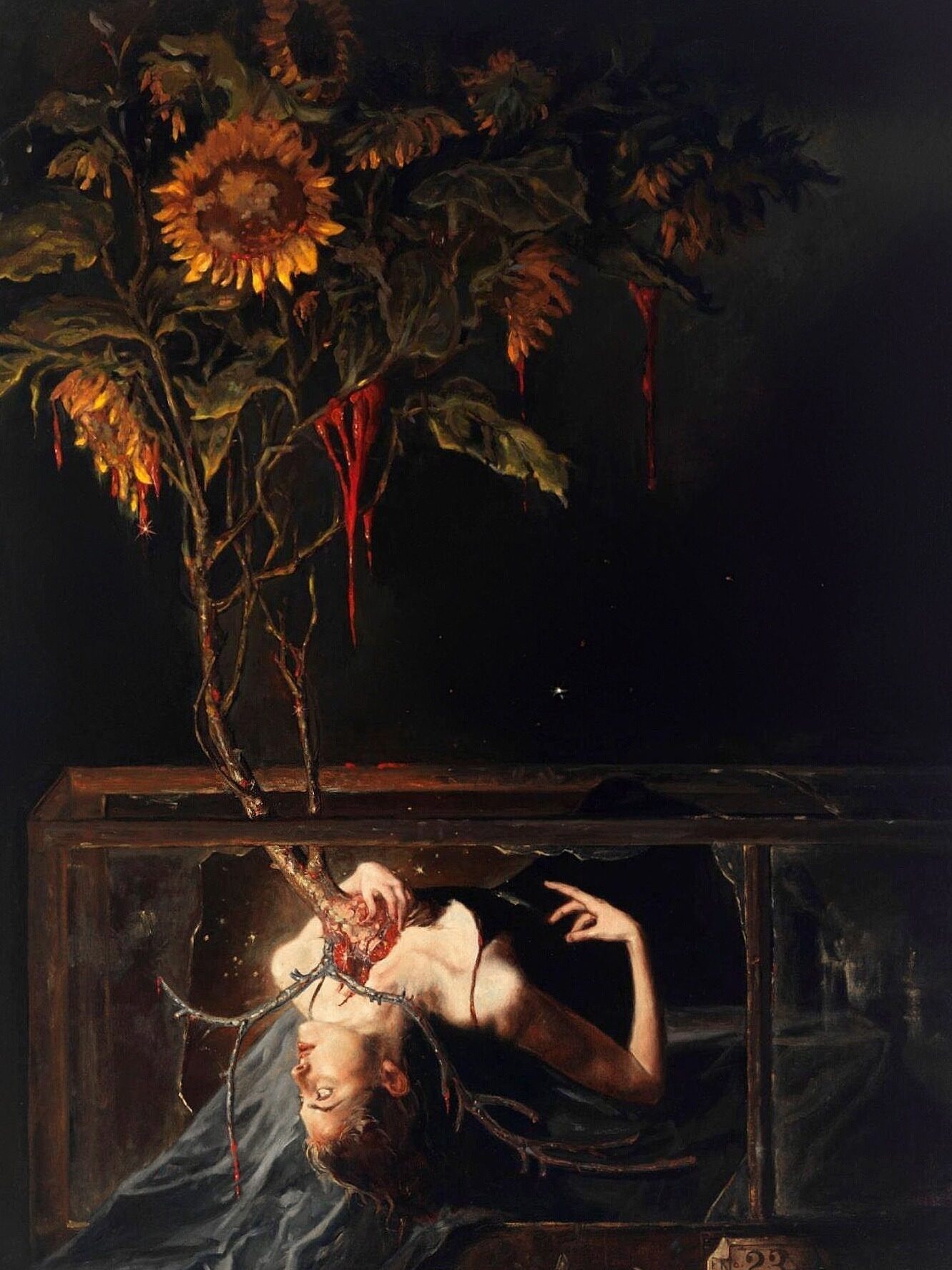
Mia’s dead ex-wife turns up in the middle of the night, dripping. She’s soggy with the smell of the lakebed and gets stinking mud all over the mat. Mia doesn’t know what to do with her, but she runs a bath that’s probably too hot and sits with her back against the bathroom door until she hears it start to drain. Then she pulls the bedsheet up over her shoulders and pretends to be asleep. In the morning they leave for a road trip, Mia and her ex-dead wife.
They don’t have an end point in mind. West, Aliya says, let’s go out west. Wherever we end up. So Mia packs for a week: six shirts four shorts eight pairs underwear two bras should be enough. With everything rolled into bundles by outfit it all fits into her smallest duffel bag. Aliya packs like she always does: armsdeep in the closet, talking the whole time. Mia watches her elbows lock and straighten as she stuffs things into a suitcase. They are the same as they’ve always been—not bloated or gray from a year at the bottom of the lake—and the skin is smooth and whole, not fishbitten. Mia stares and stares and pretends to listen. She’s sitting in the driver’s seat by nine.
After the bath Aliya didn’t smell like lake mud anymore, but like something thick and floral. Every year in July all the bushes in front of the neighbor’s house break out in tiny white flowers. At first the sweet smell is nice, but by the fourth day the flowers’ grainy shapes start to swallow up all the leaves, brilliant burning white. You can try to hold your breath when you walk by but eventually you inhale and the air is so thick and stifling that time of year that the smell snakes down your lungs and curls up there, making a home of you.
Prophecy is a Broken Line
My parents weren’t thrilled to have me in the two-bedroom apartment they had downsized to after my brother moved out, but they seemed glad that I wasn’t farming anymore. They put me on the couch in the room that wasn’t the bedroom, which managed to be everything else—storage, guest room, living room, and home office, where my mother worked from home Monday through Wednesday and my father Thursday and Friday. Often I woke up to the half-conversation of a meeting on the phone, my mother’s docile fake laugh.
When I was little, in the first apartment I can remember, above the open doorway to the kitchen were two frightening faces, Venetian masks leering down at me, one long distended nose and one grotesque devil’s smile. When we moved they vanished into a box and never came out again, but often in my dreams they showed up, the faces of shadowed figures that stretched their open hands out for me to take. It was strange to see them in real life again, smaller than I had remembered, with details that I had forgotten. I had thought the red one had its tongue lolling out; but no, it only smiled, and its teeth were blunt, and the mustache was pointed at the ends.
The Robber Girl’s Story
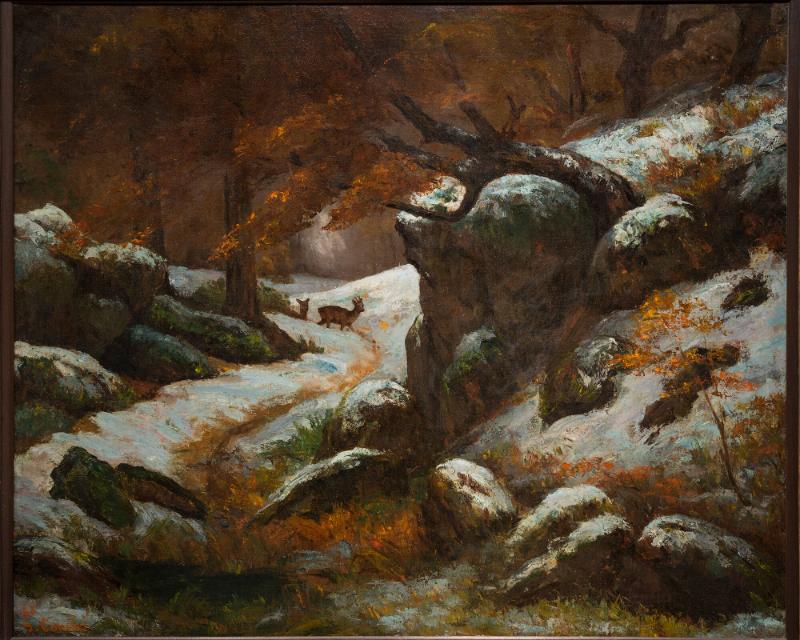
Gerda has gotten thick around the middle, barrel-like, but she still moves with that same grace like she’s floating. Makes my elephantsteps even more obvious. She fills the kettle up in the belly of the sink, an old one, stained graybeige like everything else, & I sit at the table with my hand in my other hand feeling my own skin.
Little Kay is here too, of course, not little any more. When I first got here he greeted me with plenty of kindness, his hands pressed into my shoulders and his unshaved face rough on my cheek as he kissed the air next to my ear, but since we came inside he has been sitting silent in the rocking-chair, still-shod, the small clumps of snow on his boots giving up one by one and soaking into the floor. He is looking at Gerda or perhaps into the empty middle space.
I drag my thumb across my palm & the skin is smoothsoft like a memory of silk ribbon.
Golem
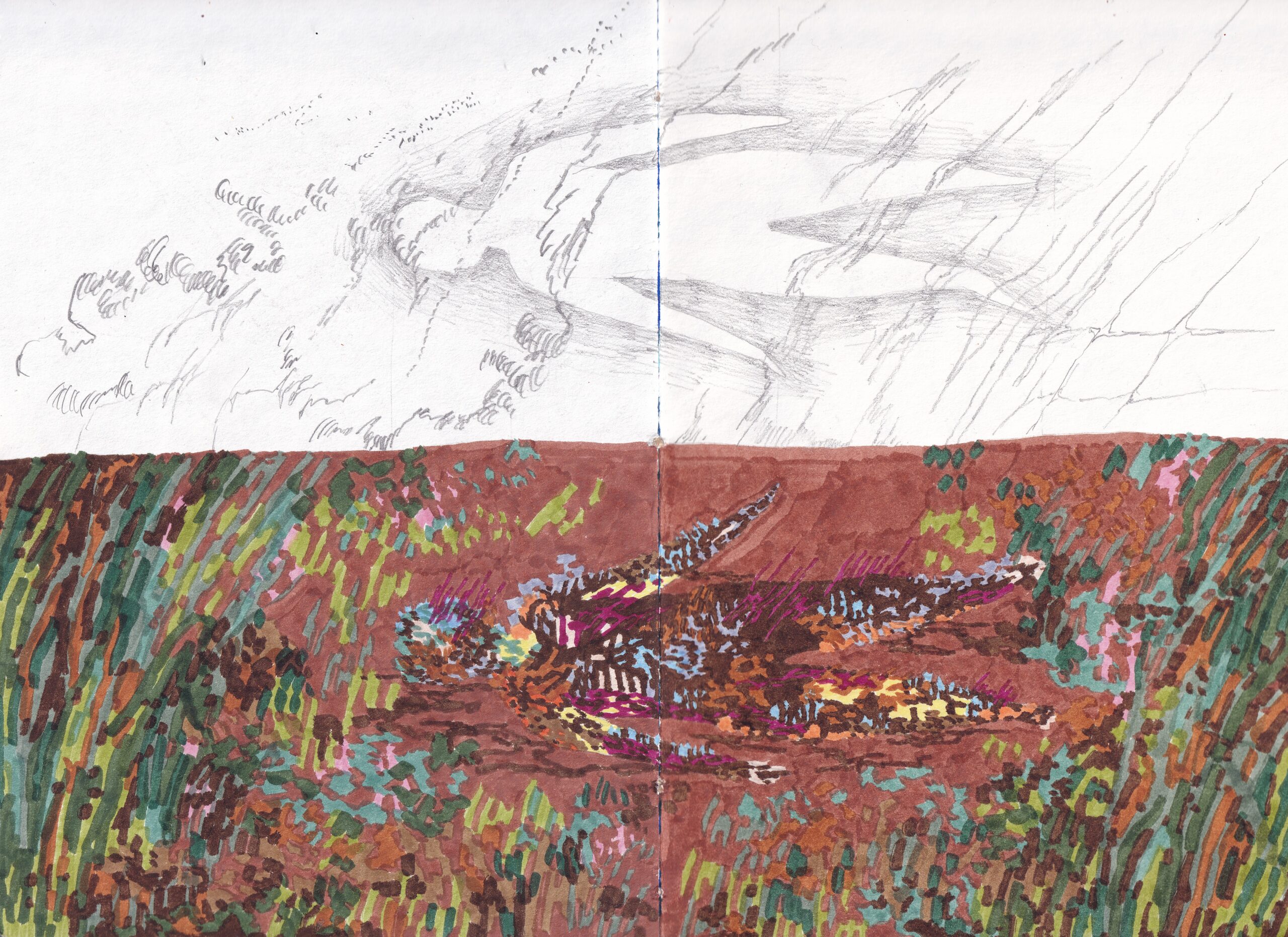
There was nobody who loved me so I built myself a lover. High on mania and drunk on old gin, I stumbled down to the riverbed and began dredging up clay. I built her from sticks and mud and blood and spit. Slapped together under the light of the moon and the buzzy overspill from the streetlight on the bridge. When the frenzy wore off I saw that she was a sad approximation of a woman, misshapen and tumorous. Feeling sober and stupid, I kicked her down and watched the mud dissolve into the river.
Wing-Longing
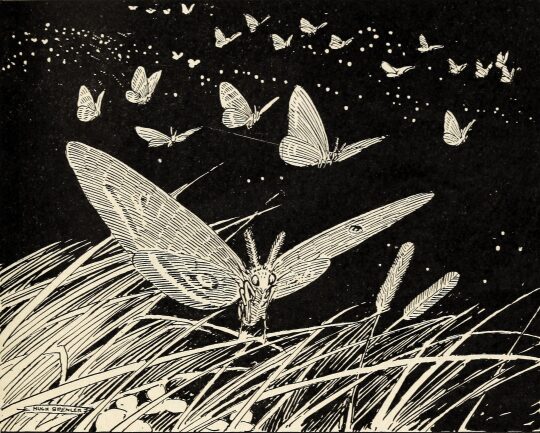
I once lived with an entomologist who was interested in moths. She was interested in anything that was small and had large wings, but mostly in moths. Large ones with soft antennae and tiny ones that could perch on your thumbnail and white furry ones that hatched in the winter and translucent green ones that used to be fat caterpillars that she would bring home and keep in jars and feed with oak leaves from the backyard.
She lived in my house and we slept together often and I cooked her expansive dinners when she came home from the lab, but when she said she loved me she was lying.
Old Growth: A Novel
Old Growth is a novel-in-progress that I’ve been working on since 2023. In newly Christian 11th-century Sweden, a small village nestled in deep forest faces the changes brought by two missionaries sent from Uppsala to convert them. Hundreds of years later in the same spot, an ash tree recounts its life, from a struggling seedling just breaking the earth to a hundred-foot tall tree watching its kin be torn down to make way for buildings and roads. Alternating between these two narratives, Old Growth explores humanity’s relationship with nature and how it changes through time as our sense of our own place in the universe shifts.
The book takes us into the heart of a tree and imagines its networks and its memories, its relationship to time and the way it conceptualizes the space between itself and the forest as a whole. In the village, the book’s rotating perspective lets us learn each villager’s struggles and yearnings: their stillbirths and their love affairs, their squabbles and their quiet deaths.
I’m interested in eco-fiction that avoids typical cli-fi narratives. Instead, I want to explore the possibilities that open up through embodying nonhuman narrators. What becomes of stories when they are told through the forest’s multiplicity of voices? What becomes of self-concept when we begin to think of all entities as truly intertwined?
The first draft of the novel was completed in February 2026 and I’m now about a quarter of the way through revisions.
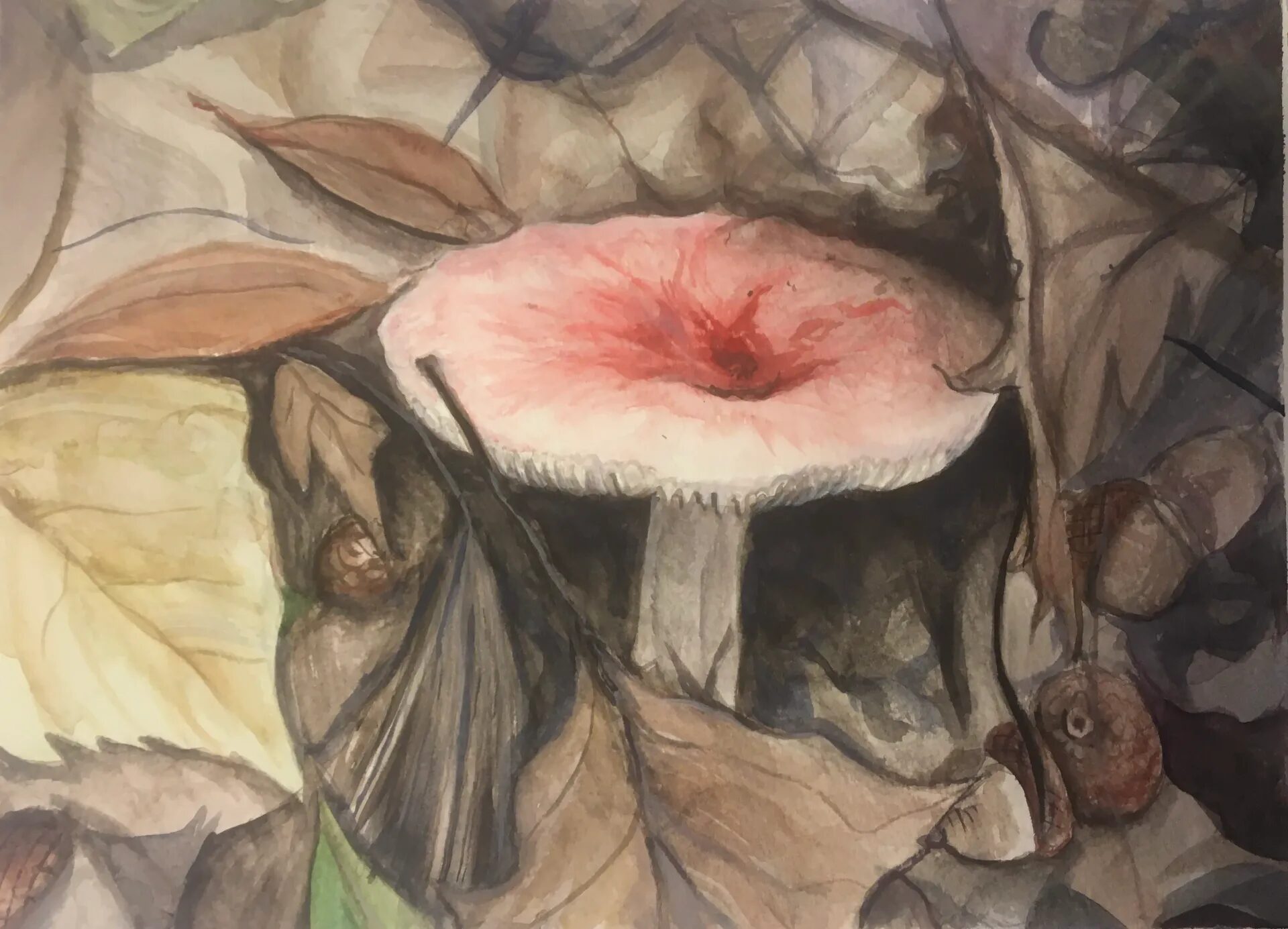
An Excerpt from Old Growth:
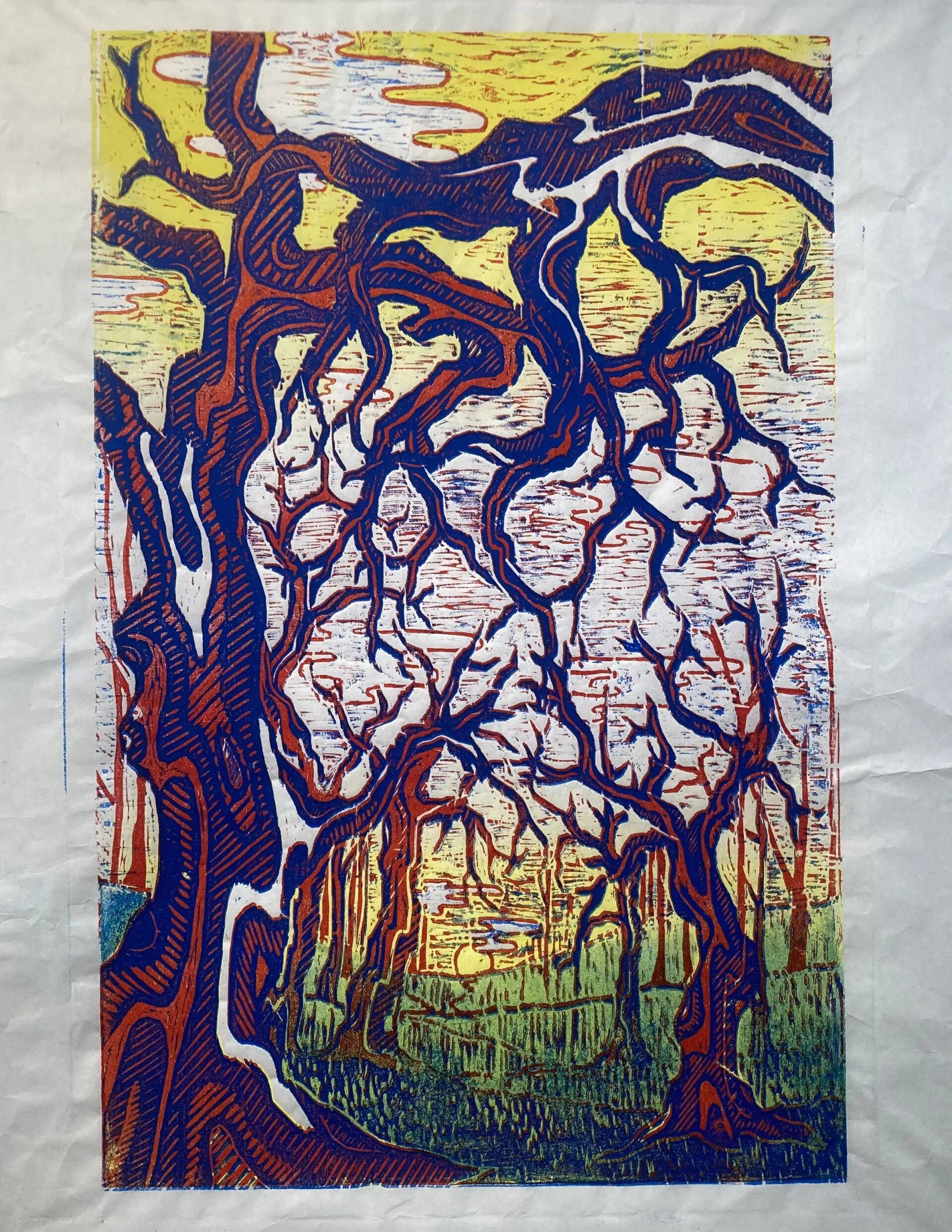
In winter, when even the air is hostile, the trees tell stories. We shrink inwards and downwards, beneath the layers of snow and frozen soil, to the root-world, where everything still lives. There, We breathe still—in water and iron, knowledge and memory; out water and phosphor, and stories. Our storytelling is not like yours: there is no one teller, no source for the spring. Stories come together, many little rivulets chattering over rock, from everything our roots can reach. From cinquefoil and blackthorn, boletes and chanterelles, into the great crashing stream that courses through us, and while the grubs sleep and the rabbits burrow,
We like stories of things that travel. Seeds carried by squalling winds from farther than our roots can reach. Willow warblers that return each spring whistling about southerly places where the trees bloom rainclouds and spiders build shimmering golden webs. And there are humans in our stories too, always talking and dancing, taking stones and trunks and soil from their places and, elsewhere, putting them together in new arrangements. You dance in and out of our stories all winter, in the memories of the raspberry bushes and the redcurrants, in the songs of curious nuthatches and the fears of harvest mice, in the shapes of the footsteps you leave in the soil, and in our own roots, under our own branches.
A thousand years ago, the forest was older. Trees stretched up far above today’s canopy, growing knots as large as foxes, roots that gnarled up from the ground higher than a man’s head. In that time, as in all times that We can remember, there are people living within the forest. In that time, as in all times, they hunt elk, they heat water from the stream until it boils, they put seeds in the ground and cut down trees and set traps for small mammals. They surround small fires and tell stories. They play besides us as children and then, older, come back to the places they used to play.
One of the children, the second-youngest of four sisters, first saw the sun eleven years ago—a narrow sapling’s age, but to the people this is a cusp, an age on the brink of waterfalling into adulthood. An age that heralds blood and sex, and solitude. Her mother and father call her Liv when they speak of her, and We call her thin-limbed lapwing-eyed, and her sisters call her many things, some of which they hope will hurt her.
On the night of the birth, Liv dresses all in a rush, so there’s something in her shoe that she doesn’t stop to get out even though it presses into the soft part of her foot painfully with every step as they hurry around the edge of the field in the dark. She imagines the shape of it burnished into her skin by the time they get to Bera’s farm, a rough red triangle right in the center of the space between the calloused pad and the heel of her right foot. Her mother’s deerhide lantern is a faint glow, but it’s easy to follow the sound of Kare’s fast breathing. He ran the whole way to fetch them, his mother’s words falling out of him: the baby is coming and it doesn’t feel right.